Practical Prospecting
Gold Panning for Beginners: From Gravel to Gold
Learn gold panning step by step, from a simple beginner kit and legal access checks to classifying gravel, recovering fine gold and avoiding common mistakes.
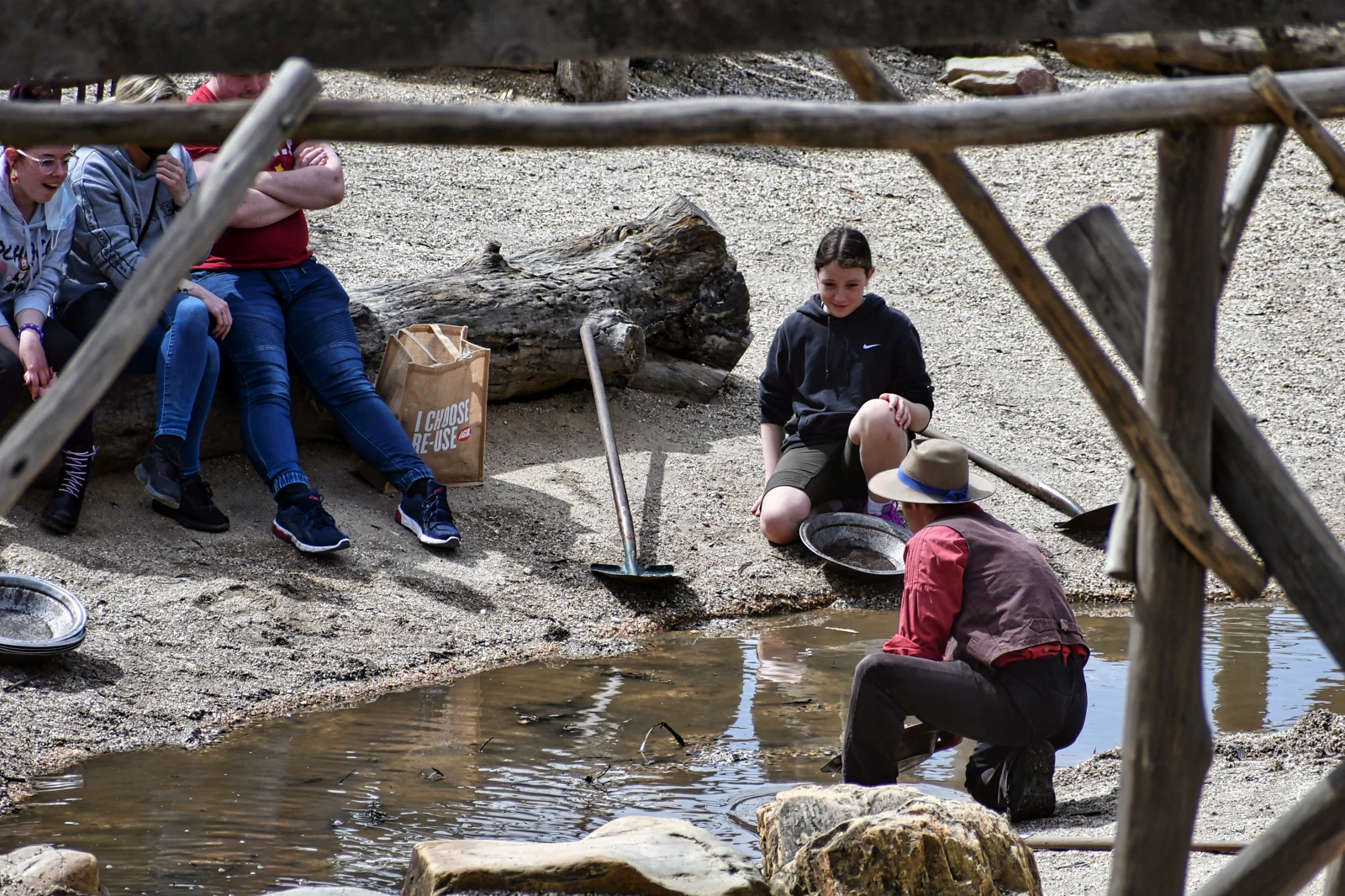
The first reward from gold panning is learning to read what stays in the pan. Gravel disappears, dark heavy minerals collect, and sometimes a tiny yellow flake remains. You do not need an expensive detector to learn the process. You need a legal place to practise, a small kit and enough patience to work slowly at the end.
Choose a Documented Place First
Start with an established fossicking area and the current guidance for that exact location. A historic goldfield, public walking track or creek on a map does not automatically give you permission to dig. Check the land manager, access conditions, any licence or miner’s-right requirement, closures and restrictions on waterways before leaving home.
In Victoria, recreational prospecting generally requires a miner’s right. Permission is still needed on private land, and some waterways are excluded even where surrounding land is open to prospecting. Check Resources Victoria, the excluded-waterway list and the relevant land manager. Other states have different systems; use our Rules and Fossicking Areas directory.
Keep Your First Kit Simple
- A plastic gold pan with a contrasting colour and moulded riffles.
- A small permitted hand scoop and a classifier or sieve.
- A bucket or tub, a small sample container and a snuffer bottle.
- Drinking water, sun protection, suitable footwear and a way to call for help.
A tub makes practice easier because you can retain the material and pan it again. Use legally obtained training material or a clearly labelled practice sample. The aim is to learn what the motions do before judging whether a creek contains gold. A pan overloaded with gravel is harder to control than a modest sample.
Why Panning Works
Panning separates material by its behaviour in water. Dense gold tends to settle through a loosened mixture while lighter sediment is gradually washed away. Heavy dark minerals can remain beside it. Their presence is useful to observe, but black sand is not proof that gold is present.
The South Australian Department for Energy and Mining’s fossicking guidance describes thoroughly breaking up clay, settling the heavy material and gently washing away the lighter fraction. The practical lesson is to separate those actions: settle first, wash a little, then settle again.
A Beginner’s Panning Routine
- Prepare the sample. Classify out oversized stones, checking that they are washed clean and not carrying attached clay.
- Wet everything. Submerge the material and work clay lumps apart. Do not rush past sticky pockets.
- Settle the heavies. Shake the pan with controlled side-to-side and gentle circular movements, keeping the contents mobile.
- Wash off a little. Tilt the pan and let water carry some lighter material over the edge. Keep the movement gentle rather than tipping everything out.
- Repeat. Alternate settling and washing as the volume reduces. Slow down when only a small concentrate remains.
- Inspect and recover. With a little clean water, carefully move the remaining sand to expose any yellow particles. Transfer possible gold into a labelled vial.
The US Forest Service’s US Forest Service — Gold Panning Guide (PDF) ↗ provide another explanation of the sequence. They describe technique, not Australian access rules. Re-pan your tailings in a tub while practising: finding a missed particle is feedback that helps you improve.
Common Mistakes to Avoid
Beginners often wash too aggressively, leave clay unbroken or discard the final heavy concentrate too quickly. Keep samples small and movements deliberate. A shiny particle also needs checking: mica and pyrite can sparkle convincingly. Our gold or fool’s gold guide compares real specimens and useful identification clues.
A magnet is not a gold detector. It may remove some magnetic minerals, but fine gold can become caught among them. Save the concentrate instead of assuming everything attracted to a magnet can be thrown away.
Leave the Site Ready for the Next Person
Avoid unstable banks, deep or fast water and old mine openings. Check weather and access conditions, use only permitted equipment, protect vegetation and heritage, restore permitted disturbance and remove rubbish. Join a local prospecting club or an authorised introductory session if you want help with the technique.
Keep a short notebook: where you were allowed to sample, what material you tried and what remained after panning. The useful first milestone is a repeatable method. A cleanly worked pan teaches you more than a hurried search for a spectacular nugget.
Sources and Further Reading
- Resources Victoria - Recreational Prospecting
- Resources Victoria - Excluded Rivers and Streams
- Parks Victoria - Fossicking and Prospecting
- South Australia - Fossicking Equipment and Technique
- US Forest Service — Gold Panning Guide (PDF) ↗
Sources checked 14 November 2026. Original educational article by Gold Strike / Strike Labs. Images and historical examples are identified separately.