Gold rush legends
Australia’s biggest gold nuggets
The extraordinary finds that turned ordinary ground into goldfields history.
Australia
A nugget so big it had to be broken up before it could be weighed. Another found deep beneath Ballarat. A third discovered with a metal detector more than a century after the Victorian gold rush began. Australia’s great gold finds are remarkable for much more than their size.
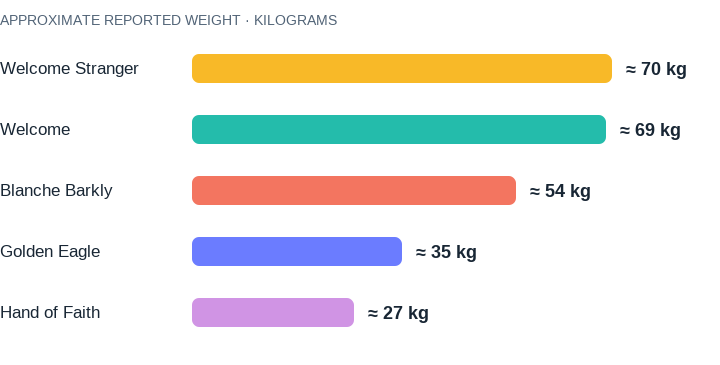
The Welcome Stranger is the best-known giant, but it is only part of the story. These five famous Australian nuggets span Victoria and Western Australia, from the rushes of the 1850s to a detector find in 1980.
Five famous giants at a glance
| Nugget | Found | Location | Approximate reported mass |
|---|---|---|---|
| Welcome Stranger | 1869 | Moliagul, Victoria | 70 kg |
| Welcome | 1858 | Ballarat, Victoria | 69 kg |
| Blanche Barkly | 1857 | Kingower, Victoria | 54 kg |
| Golden Eagle | 1931 | Larkinville, Western Australia | 35 kg |
| Hand of Faith | 1980 | Kingower, Victoria | 27 kg |
These are five famous giants, not a complete ranking of Australia’s largest finds. Weights are rounded reported nugget masses. Historical sources variously report gold with attached material, cleaned nuggets or recovered gold after melting; these figures should not be read as a precise comparison of pure-gold content.
Welcome Stranger
The giant beneath a tree
5 February 1869 · Moliagul, Victoria · About 70 kg
John Deason was working at Bulldog Gully, near Moliagul, when he uncovered gold beside the roots of a tree. Only a thin layer of soil separated him from a discovery that would become an enduring symbol of the Australian goldfields.
Deason and his partner Richard Oates recovered the nugget and eventually took it to Dunolly. It was too large for the bank’s scales, so it was broken into smaller pieces on an anvil before weighing. The original nugget did not survive intact.
That is what makes the Welcome Stranger story so striking: an extraordinary mass of gold lay almost at the surface. Geoscience Australia gives its weight as 70 kg. Museum accounts use different figures, so “about 70 kg” is more useful here than an apparently exact number.
Sources: Museums Victoria — Welcome Stranger · Geoscience Australia — Gold
Welcome
A different giant, deep underground
9 June 1858 · Ballarat, Victoria · About 69 kg
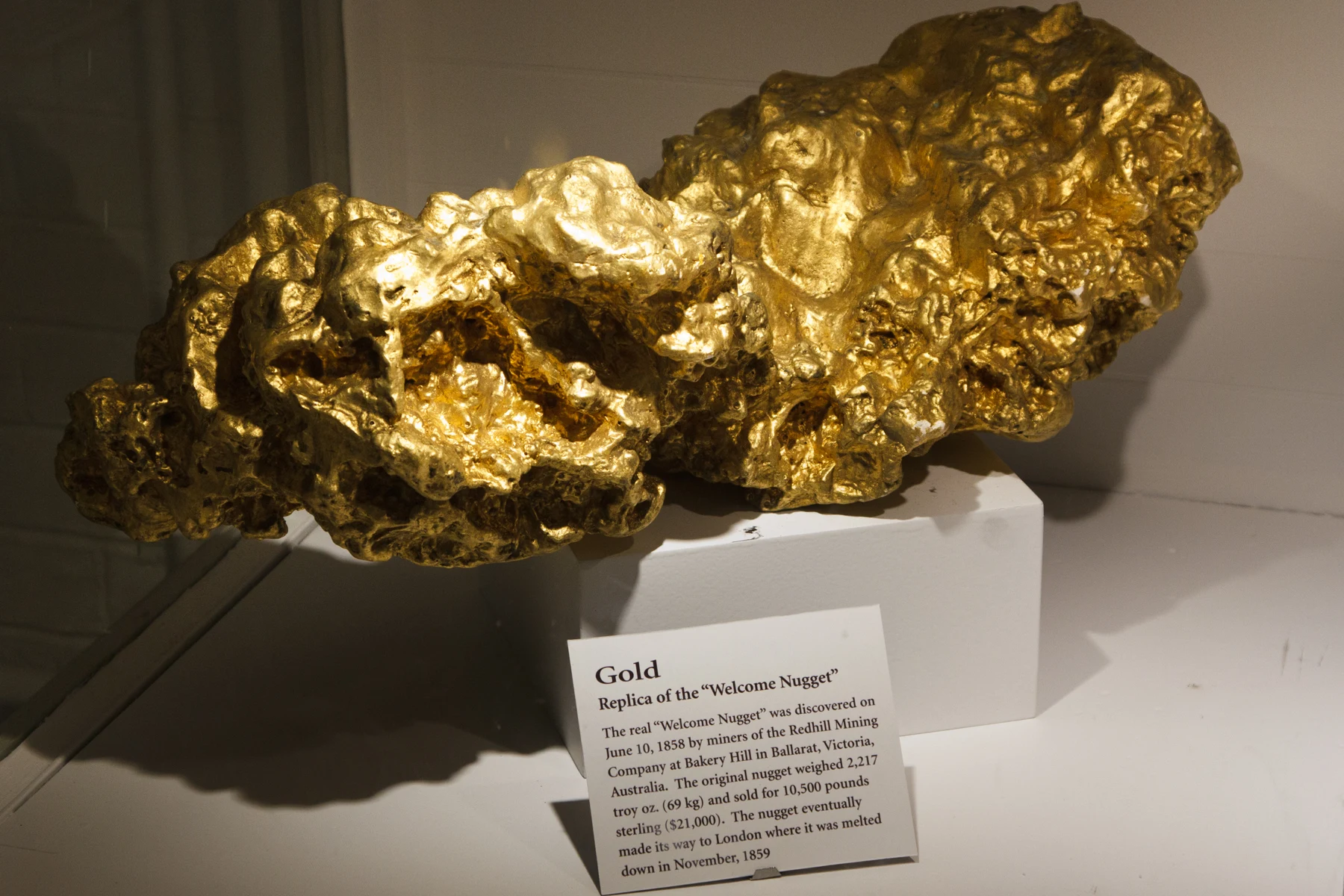
The Welcome nugget and Welcome Stranger are separate discoveries. The Welcome came first, found by a party of 22 Cornish miners at Bakery Hill in Ballarat. Unlike the near-surface Welcome Stranger, it emerged from workings about 55 metres underground.
Geoscience Australia records its weight as 68.98 kg. It was an immense reward for miners whose work involved shafts and tunnels rather than a walk across open ground.
The Australian Museum records that the nugget was melted in London in November 1859. Its shape lives on through replicas. The colour photograph at the top of this article shows a replica at Harvard Museum of Natural History, rather than the original gold.
Sources: Geoscience Australia — Gold · Australian Museum — Welcome nugget replica
Blanche Barkly
Kingower’s gold-rush heavyweight
27 August 1857 · Kingower, Victoria · About 54 kg
Before either of the two famous Welcome discoveries, Kingower produced the Blanche Barkly. Robert and James Ambrose, together with Charles and Samuel Napier, found it during the Victorian gold rush.
Dunolly Museum reproduces a contemporary newspaper account giving its weight as 1,743 ounces and 13 pennyweights. Read as troy weight, that is approximately 54 kg. It was named after Blanche, daughter of Victorian Governor Sir Henry Barkly.
The name sounds delicate; the mass was anything but. This was a lump of gold heavy enough to make an ordinary lifting task a serious challenge. Its story also puts Kingower firmly on the map well before the Hand of Faith was discovered there.
Sources: Dunolly Museum — Blanche Barkly
Golden Eagle
Western Australia’s wing-shaped wonder
15 January 1931 · Larkinville, Western Australia · About 35 kg
Australia’s giant-nugget stories are not confined to Victoria. At Larkinville, south of Coolgardie, the Larcombe family found the Golden Eagle in 1931. Museums Victoria’s record identifies the discoverer as the 17-year-old son, Jim Larcombe.
The museum records a weight of 1,135 ounces and 15 pennyweights—roughly 35 kg in troy measure. Its broad, irregular outline helped give the nugget its memorable name.
The Western Australian Museum describes the Golden Eagle as the state’s largest nugget and records that it was melted in December 1931. Like several Victorian giants, its appearance is now represented by photographs and replicas rather than the original object.
Sources: Museums Victoria — Golden Eagle historical photograph and record · Western Australian Museum — Gold nuggets
Hand of Faith
The detector find that survived
26 September 1980 · Kingower, Victoria · About 27 kg
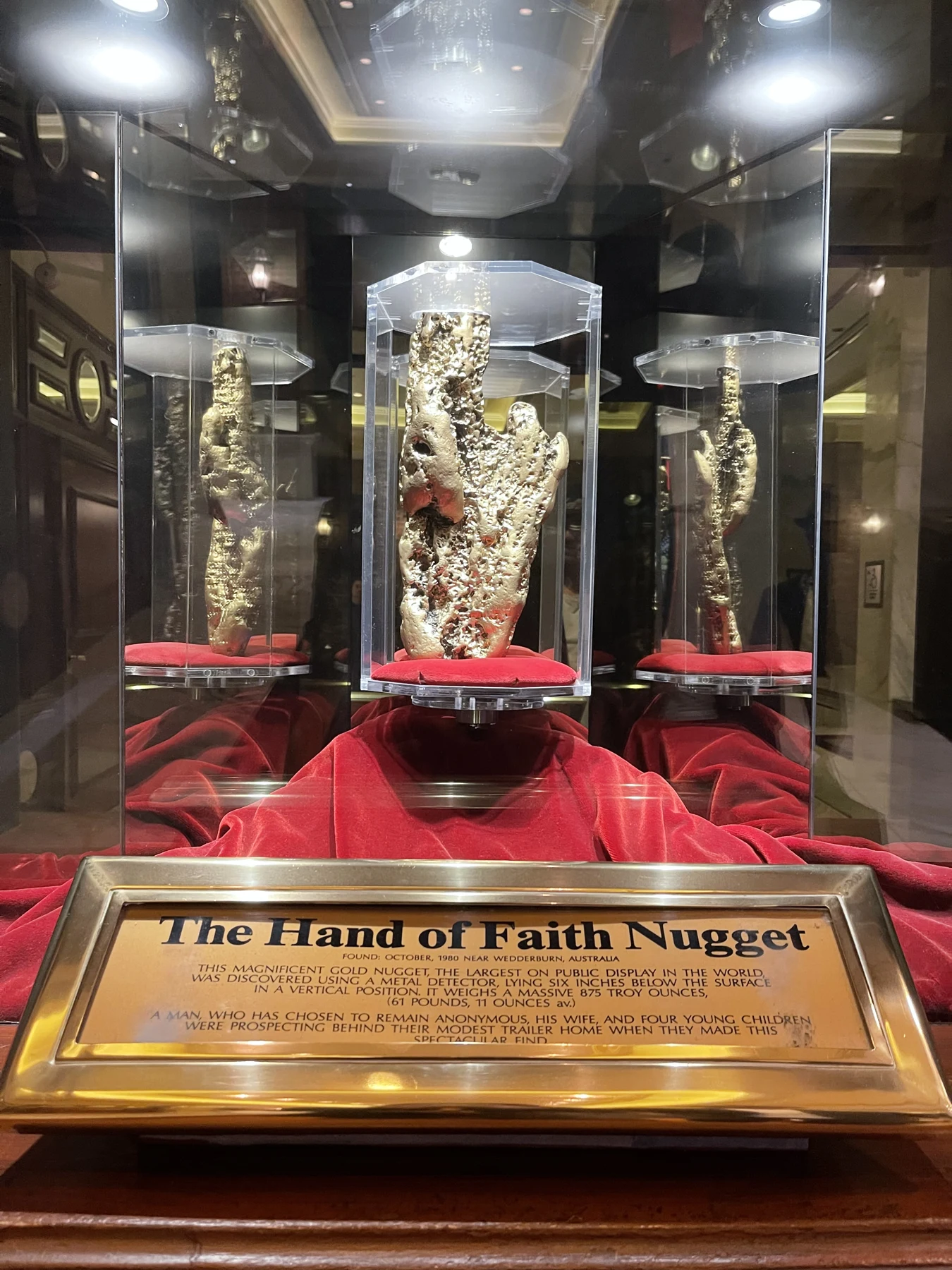
The Hand of Faith brings the story into the metal-detector era. Kevin Hillier discovered it at Kingower, near Wedderburn, in September 1980. The finder’s account places the discovery behind the old Kingower primary school.
At about 27 kg, it is smaller than the other nuggets featured here, but its survival makes it especially compelling. This is an actual giant nugget people can still see, rather than a shape reconstructed after the gold was melted.
It was sold to the Golden Nugget in Las Vegas, whose website lists it as a lobby attraction. The photograph below shows it on display in 2022. A Victorian discovery became an attraction on the other side of the Pacific.
Sources: Hand of Faith — finder’s story · Golden Nugget — Hand of Faith display
Where does the Holtermann specimen fit?
The famous Holtermann find at Hill End in New South Wales often appears in lists of giant nuggets. It was a spectacular gold-bearing quartz specimen: gold still attached to a large mass of rock. The State Library of NSW’s archived exhibition describes that distinction. Putting its total rock-and-gold weight beside a mostly gold nugget produces a misleading comparison, so it is treated separately here.
Source: State Library of NSW — Holtermann at Hill End (archived exhibition)
Why Australia’s nugget stories endure
Gold can form in mineralised veins, often associated with quartz. As rock weathers, gold can be released and concentrated in sediments. Geoscience Australia describes this process as the origin of alluvial deposits. The stories above show that spectacular finds have come from very different settings: near the surface, deep underground and in ground searched with a detector.
Source: Geoscience Australia — Gold
The appeal of these discoveries is easy to understand. A tree root, a mine tunnel or an ordinary patch of ground became the setting for something extraordinary. They are landmarks in Australia’s gold history, rather than a guide to what a prospecting trip will produce. Their real legacy is the combination of geology, persistence and astonishing luck behind each find.
Common questions
What is Australia’s most famous giant gold nugget?
The Welcome Stranger, found near Moliagul in 1869, is the best-known example. Its commonly cited weight is about 70 kg. Historical accounts differ in how they report its weight.
Are the Welcome and Welcome Stranger the same nugget?
No. The Welcome was found at Ballarat in 1858. The Welcome Stranger was found near Moliagul in 1869.
Can you still see any of these original nuggets?
The Hand of Faith survives and is listed as an attraction by the Golden Nugget in Las Vegas. Other famous finds are represented in museums by replicas; check each display label.
Image credits
Welcome nugget replica, Harvard Museum of Natural History. Photograph: Anatoli Lvov, 2012. CC BY-SA 3.0. Resized and converted to WebP; the photograph remains under the same licence. Source · Licence
Hand of Faith on display in Las Vegas, photographed in March 2022. Sarah Stierch (CC BY 4.0). Resized and converted to WebP. Historical display signage may differ from the finder’s account used for the discovery date. Source · Licence