Practical Prospecting
Black Sand in Your Gold Pan: What It Means
You’ve washed away most of the gravel, and a stubborn dark streak remains. Is it a good sign—or just the part that makes the last few flakes hard to see?
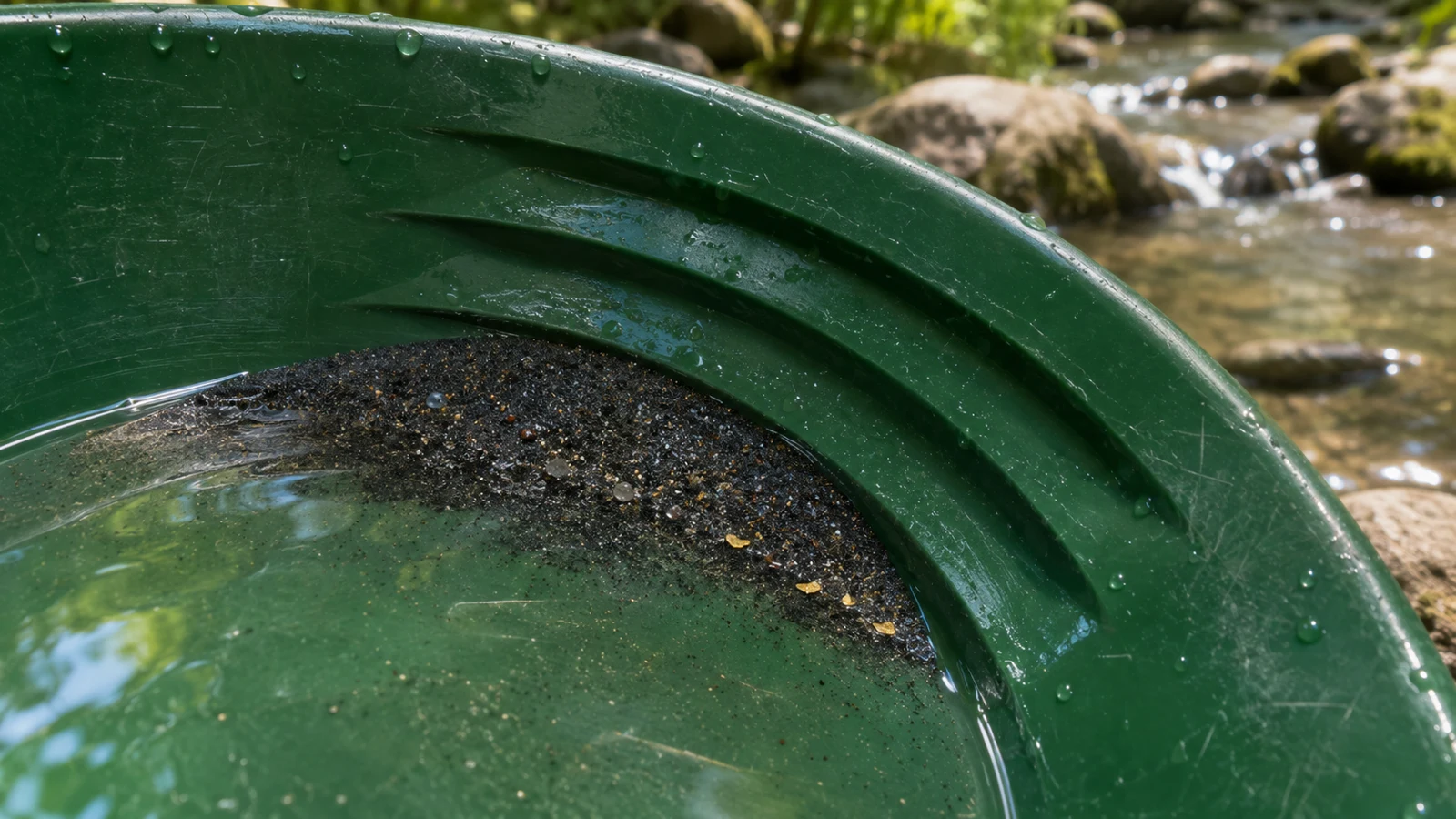
That dark material is often called black sand. It can be an encouraging sight because your pan has concentrated heavy minerals. But a pan full of black sand can still contain no gold at all. The useful question is what’s mixed in with it, and how carefully you handle the final concentrate.
Black Sand Isn’t One Mineral
The name describes an appearance, not a single substance. Magnetite and ilmenite are common contributors to dark heavy-mineral sands; other minerals can join the mixture. The exact contents depend on the rocks the sediment came from.
Magnetite is an iron oxide that is strongly attracted to a magnet. Hematite is another iron oxide, with a reddish-brown streak when powdered. Looking at a wet, dark grain alone won’t reliably tell you which mineral you have.
Why Does It Stay in the Pan?
Panning uses differences in how particles settle and move in water. As lighter material washes away, denser grains tend to remain. Black sand and gold can end up together because both belong to that heavier fraction—not because black sand creates gold.
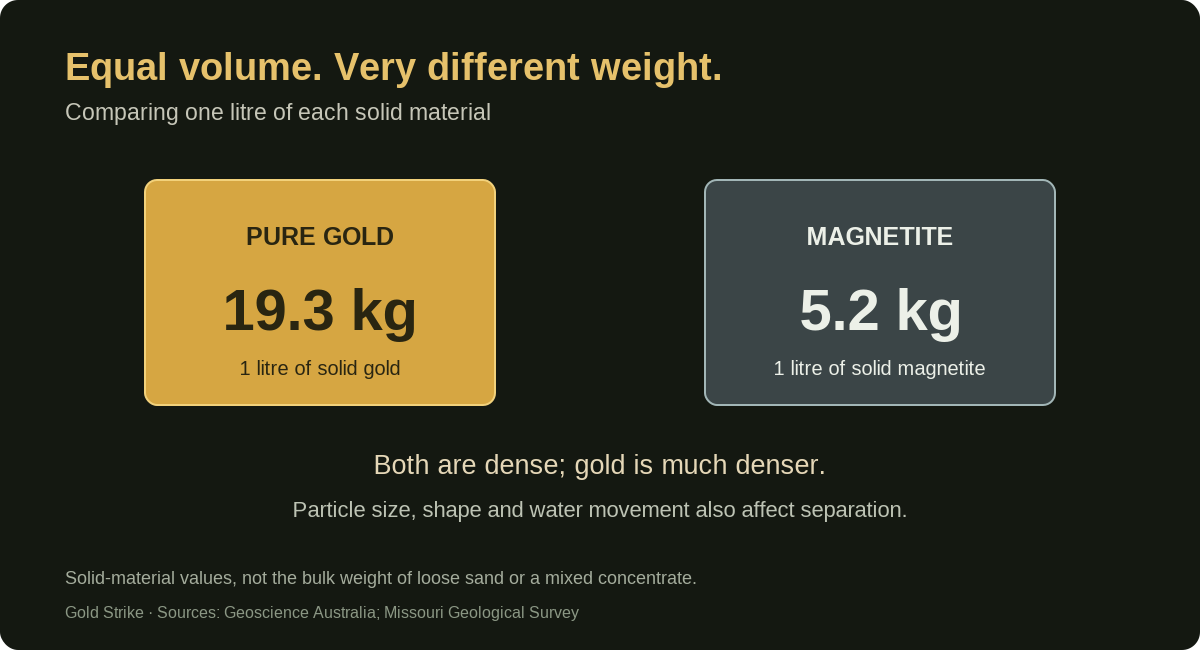
For perspective, pure gold has a density of about 19.3 grams per cubic centimetre, compared with roughly 5.2 for magnetite. Gold is much denser, but grain size, shape and your panning motion also matter. A tiny flat flake can still escape if you rush.
A Clue Worth Checking, Not a Gold Test
A dark concentrate tells you that heavy grains have collected. It doesn’t tell you how much gold is present, whether the next pan will contain any, or whether the material came from a worthwhile deposit.
Treat it as a reason to look closely. If you’re comparing samples from places you’re permitted to work, record the location, a similar starting volume and the gold actually recovered. “More black sand” and “more gold” are different observations.
Slow Down for the Last Little Bit
When only a small concentrate remains, use gentle water movements to spread it into a thin trail. Give yourself good light and a clear view. The final cleanup is often easier over a second container, so anything accidentally washed out can be checked again.
Work on a small portion if the pan feels crowded. A hand lens can help you inspect individual grains, while a snuffer bottle can collect separated flakes. Keep the remaining concentrate until you’re satisfied you haven’t left fine gold behind.
What Can a Magnet Do?
A magnet can remove some magnetic grains, reducing the amount left to sort. It won’t lift every dark mineral, and the material left behind isn’t automatically gold.
Try a small amount first. With the magnet inside a clean plastic bag, lift a little magnetic material from a thin layer of concentrate, then release it into a separate container by withdrawing the magnet from the bag. Keep the two portions separate and inspect both: small gold particles can be carried along with clumped grains even though gold itself isn’t attracted to an ordinary hand magnet.
Make the Concentrate Work for You
The goal isn’t to finish with the darkest pan. It’s to separate and recognise whatever gold is actually there. Careful cleanup, retained tailings and a few clear notes can teach you far more than tipping everything out and moving on.
If you’re still building your technique, start with our gold-panning guide. For confusing yellow grains, the gold and fool’s gold comparison is the next useful read.
Sources and Further Reading
- Washington Geological Survey — Recreational Gold Panning (PDF)
- US Forest Service and Bureau of Land Management — Gold Panning (PDF)
- Missouri Geological Survey — Iron Minerals
- Geoscience Australia — Gold Properties
- US Geological Survey — Heavy-Mineral Prospecting
- NASA Space Math — Exploring Magnetism (PDF)
Sources checked 16 November 2026. Overseas guides are used for geology and panning technique; their regional access rules do not apply in Australia. Original article by Gold Strike / Strike Labs.