Detecting Guide
Ground Balance and Hot Rocks Explained
The coil sounds promising. You dig, the signal changes, and there is no obvious metal. Sometimes the loudest thing in a goldfield is the ground itself.
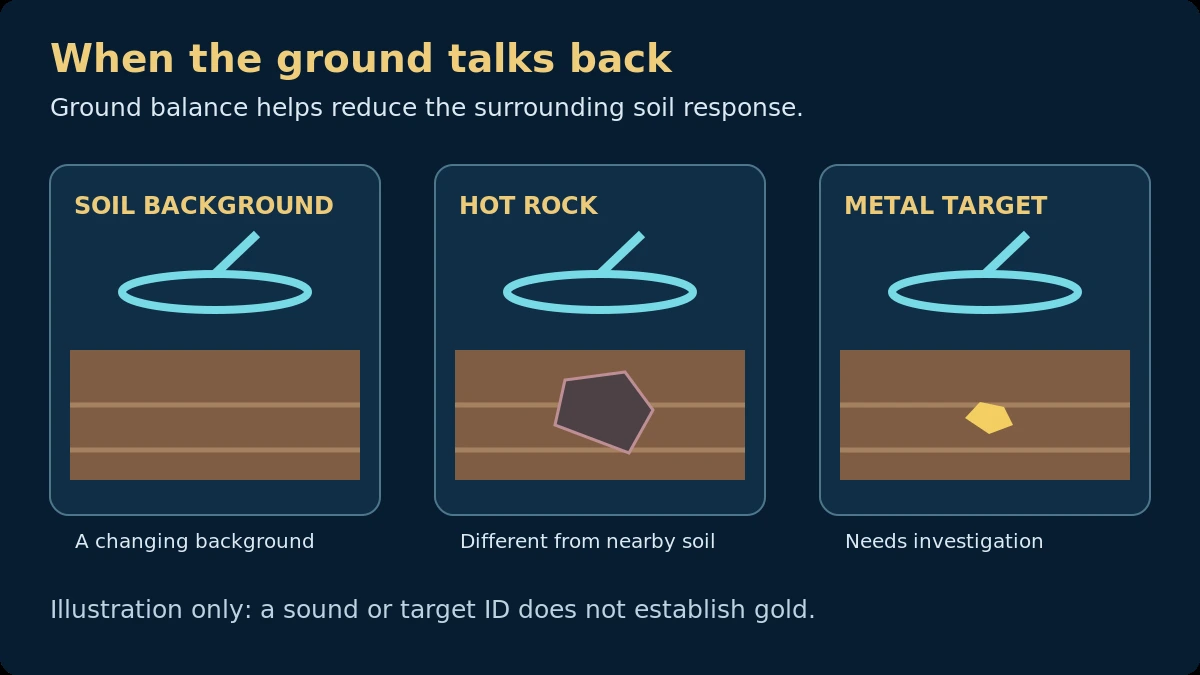
A detector has to work among signals from the soil as well as from buried objects. Mineralisation can vary across a patch, producing broad rises, falls or unstable audio as the coil moves. Ground balance adjusts how the machine handles that background response. It helps make the ground less intrusive so a target has a better chance of standing out; it does not identify what a target is.[1]
What Makes a Rock “Hot”?
Hot describes a rock’s response relative to the surrounding soil, rather than its temperature. A strongly mineralised stone in milder ground is one example. Because that stone differs from the material used to balance the detector, it can produce a distinct response that is easily confused with a nugget. A field can also contain several different kinds of troublesome rock.[1]
Ground Balance Is a Trade-Off
Some machines offer automatic adjustment, continuous tracking and a fixed setting. Tracking follows changing ground, which can make a noisy patch easier to search. But Minelab’s EQUINOX guidance notes that tracking can also filter subtle changes from very small or deep gold. Fixed balance avoids that particular ongoing adjustment, while asking the operator to rebalance when the ground changes. The best choice depends on the detector, search mode and ground.[2]
Do not copy another model’s ground-balance number or assume every detector uses the same method. Minelab’s GPZ 7000 FAQs describe ferrite-assisted sweeping; other machines use a pumping procedure. Use the instructions for the machine and coil actually in your hand. [3]
A Practical Way to Investigate a Signal
First, check the detector’s balance over a nearby patch without a target. Keep the coil height and sweep steady, then return to the response. Listen from more than one direction and note whether it stays in the same small place. These are observations to guide the investigation, not a gold test. A repeatable response can still be rubbish or mineralised rock.[2]
Where your model’s manual recommends it, switch from tracking to fixed balance after balancing away from the suspected target. This lets you examine the response without continually asking the detector to adapt to the same spot. If material is removed, check the hole and the removed material separately. A signal that follows a particular stone is useful evidence about its source; it does not prove that the stone contains no gold.[2]
Less Noise Can Be More Useful
Maximum sensitivity is not automatically the most productive setting. Minelab’s GPZ 7000 FAQs explain when Difficult or Severe ground settings can help in noisy soils. A stable, understandable response is more useful than a loud background that masks every small change. Adjust one control at a time so you can hear what it changed. [3]
A Target ID Is Another Clue
The EQUINOX manual describes typical differences between hot-rock and small-gold target IDs in its gold modes. Those are model-specific indications, not a universal rule that a negative number means rock or a positive number means gold. Ground conditions, depth and target properties complicate the picture. Treat an identification number as part of the evidence, alongside repeatability and careful recovery.[1]
The aim is not to make every awkward sound disappear. It is to understand the background well enough to recognise a response worth investigating—and to know when a setting is making that response harder to hear.
Sources and Further Reading
- Minelab — EQUINOX instruction manual, gold mode and hot rocks ↗
- Minelab — Gold Nugget Hunting with EQUINOX ↗
- Minelab — Ground Balance and Difficult-Ground FAQs ↗
Source pages checked 19 November 2026.