Gold Detecting
VLF vs Pulse Induction: Choosing a Gold Detector
The best detector on paper is not always the easiest detector to hear in the field. Start with the ground, the gold you hope to find and the way you will search.
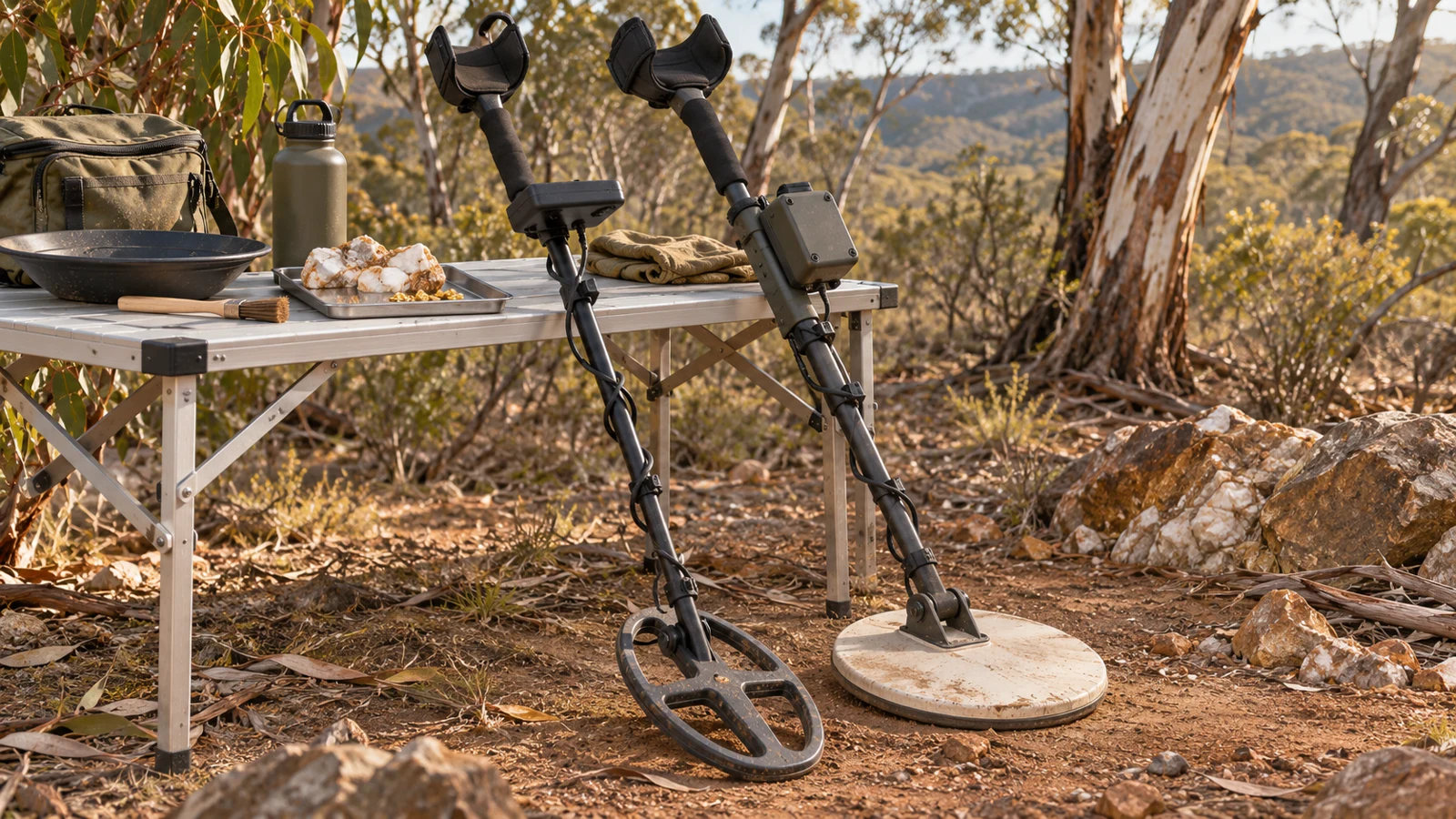
The Ground Gets a Vote
A detector that sounds calm on one patch can become exhausting on another. Goldfields often contain iron-rich minerals that produce signals of their own. The question is therefore not simply which detector detects metal: it is which combination of machine, coil and settings lets you recognise a small target against that particular background. Ground balance is central to this job. [1]
What VLF Does
Very-low-frequency detectors transmit an alternating electromagnetic field and examine the response received from the ground and nearby metal. The target response helps the detector distinguish between materials, although an identification reading is an estimate rather than a chemical test. Frequency, target size, orientation and soil all influence the result. [1]
Gold-oriented VLF machines can be effective on small, shallow nuggets. Minelab’s EQUINOX guidance describes using its Gold modes and adapting sensitivity and ground balance to conditions. High sensitivity is useful only while the background remains readable; a smaller coil can also help work around obstacles and separate nearby responses. These are choices to test on site, not a promise that every VLF will behave alike. [2]
What Pulse Induction Changes
Pulse-induction detectors send short pulses into the coil, then examine the response after transmission. Their timing lets the instrument reduce much of the ground response while retaining useful target information. In strongly mineralised goldfields this can give a practical advantage, but PI is not immune to every soil, salt condition or hot rock. [3]
Minelab’s technical discussion distinguishes the dominant ground response from residual magnetic effects that can still trouble a detector. Timing and ground-balance choices matter. Its ZVT technology is a separate approach, so the familiar VLF-versus-PI split does not neatly describe every gold detector sold today. [4]

Choose for the Search You Will Actually Do
Before comparing brochures, write down your likely ground, target size and hours in the field. Then ask a dealer or experienced operator to demonstrate suitable machines in comparable conditions. A repeatable response from your own test target is more informative than a depth claim without a stated target and soil.
| Your priority | What to compare in the field |
|---|---|
| Small, shallow gold | A gold-oriented VLF and an appropriate small coil; compare target response against the actual ground noise. |
| Strong mineralisation | A suitable PI, its available timings and ground handling; check how much useful sensitivity remains. |
| Mixed gold and rubbish | Identification behaviour, recovery speed and the cost of rejecting an uncertain signal. |
| Long walking sessions | Total weight, balance, harness, battery arrangement and whether you can keep a consistent sweep. |
Do not turn the table into a ranking. Detector model, operator skill and local conditions can overturn an easy generalisation. A borrowed machine or supervised test can answer questions that a specification sheet cannot.
A Signal Is the Beginning
Learning a detector includes learning what makes it unstable. Keep notes, change one setting at a time and recheck a response from another direction. Read our ground-balance and hot-rock guide before deciding that a noisy machine needs replacing. The detector you understand well can be a much more useful tool than an expensive one you continually fight.
Sources and Further Reading
- Minelab — How Detectors Work ↗
- Minelab — Nugget Detecting With the EQUINOX ↗
- Minelab — Metal Detecting Terminology (PDF) ↗
- Minelab — Basics of GPZ 7000 ZVT Technology (PDF) ↗
Source pages checked 20 November 2026.